Perspective Transform
The homography, also known as the perspective transform, is a geometric transformation that relates 2 different planes. Straight lines will remain straight after the transformation:
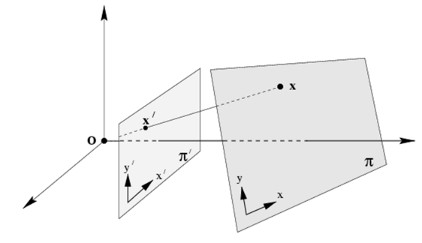
In the above figure, each point $(x, y)$ of the plane $\pi$ corresponds to a point $(x’, y’)$ of the plane $\pi’$. Their relation can be represented by the following equation:
\[s \begin{bmatrix} x^{'} \\ y^{'} \\ 1 \end{bmatrix} = \mathbf{H} \begin{bmatrix} x \\ y \\ 1 \end{bmatrix} = \begin{bmatrix} h_{11} & h_{12} & h_{13} \\ h_{21} & h_{22} & h_{23} \\ h_{31} & h_{32} & h_{33} \end{bmatrix} \begin{bmatrix} x \\ y \\ 1 \end{bmatrix}\]given:
- $s$ is a scale factor
- $H$ is a homography matrix that has a shape
3x3but with 8 DoF (degrees of freedom)
To find this transformation matrix, you need 4 points on the input image and corresponding points on the output image. Among these 4 points, 3 of them should not be collinear.
– # Affine Transformation
Definition
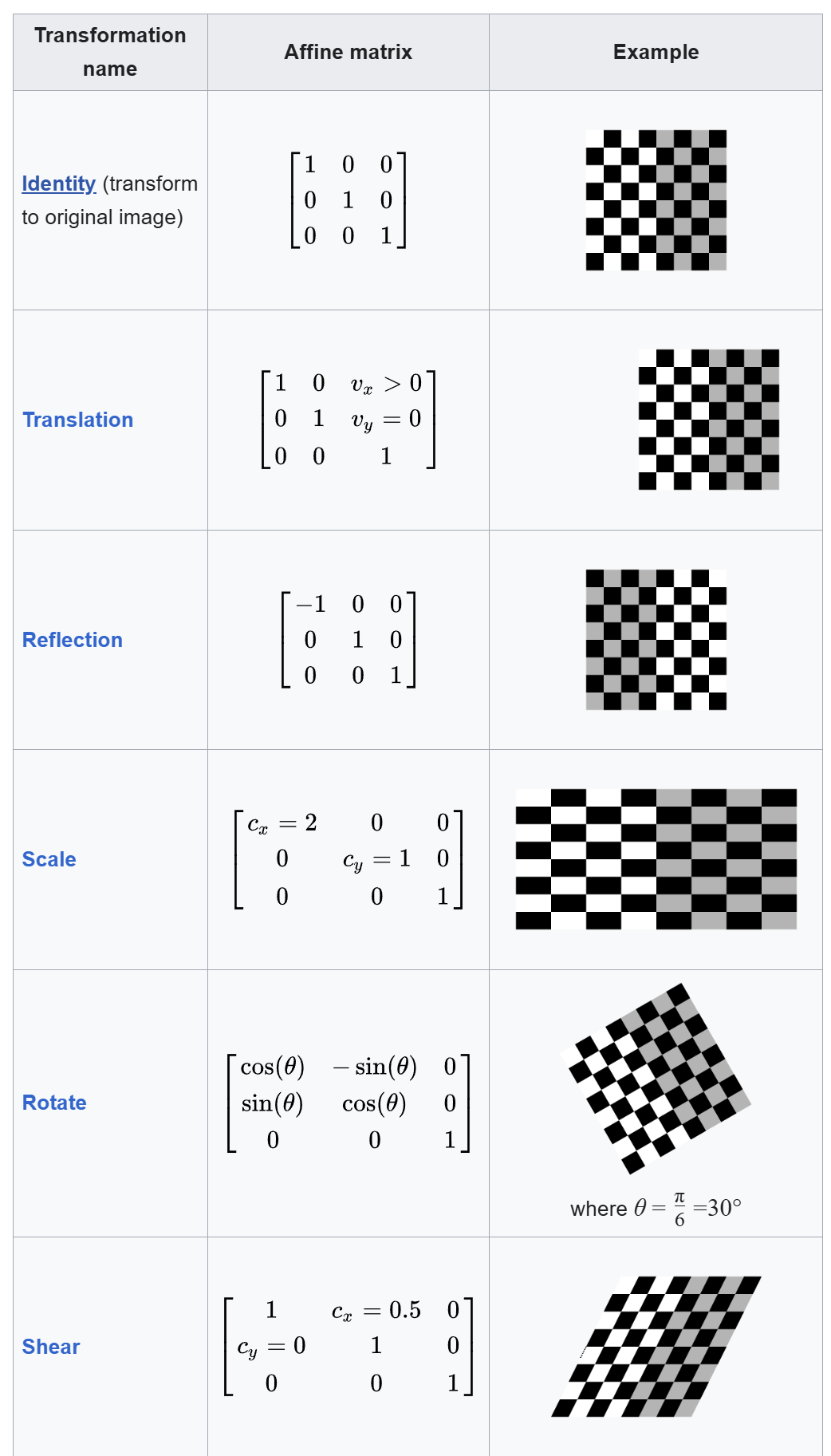
An affine transformation or affinity is a geometric transformation that preserves lines and parallelism but not necessarily Euclidean distances and angles. This means that:
- Points on the same line initially lie on a line after the transformation
- Parallel lines before the transformation remain parallel after the transformation
- The ratio of any pair of segments remains the same after the transformation. Hence, a segment’s midpoint remains the midpoint.
Examples of Affine Transformations:
- Translation: Moving a figure without changing its orientation or size.
- Rotation: Turning a figure around a point.
- Scaling: Enlarging or shrinking a figure.
- Shearing: Skewing a figure.
Equation